Meditation in a Spiritual Retreat in Thailand: A Beginner's Guide
Want to truly slow down during your Thailand trip? Discover what a meditation retreat entails: silence, Buddhist rituals, and monastic life.
Whether you're a beginner or more experienced, meditation always has much to teach us. Through its Buddhist traditions and culture, Thailand is home to numerous centers and monasteries where you can learn and practice meditation techniques. Whether through a few hours of classes or multi-day retreats and programs, come discover the art of meditation during your Thailand journey.
What to Expect During a Meditation Retreat at a Thai Center
Understanding and Respecting the Precepts
Meditation retreats and programs are extraordinary experiences. If you wish to learn more about yourself, a whole new world awaits you... But you must be ready! Indeed, if you undertake a meditation retreat at a Buddhist center in Thailand, you will need to respect a number of rules. Starting with the 5 precepts:
refrain from lying,
refrain from stealing,
refrain from sexual relations,
refrain from alcohol or substances that cloud the mind and body
refrain from killing.
Some meditation centers go even further, with 3 additional precepts:
refrain from eating after noon (a Buddhist monk does not eat between midday and sunrise).
refrain from seeking comfort or superficiality (no « decoration », an invitation to simplicity)
refrain from entertainment.
Regarding this last point, if you commit to such a strict establishment, note that you will not be able to listen to music, use your mobile phone, or in some cases, even speak or write.
During a meditation retreat, these precepts also apply to yoga practice. Indeed, discipline must be practiced with humility (without seeking to impress others) and in modest clothing.
Furthermore, except in emergencies, it is frowned upon to leave the meditation center and abandon your retreat to shop for even the most basic necessities... Before departure, make sure to bring everything you need for the entire stay (and in particular toiletries).
Wearing White Clothes
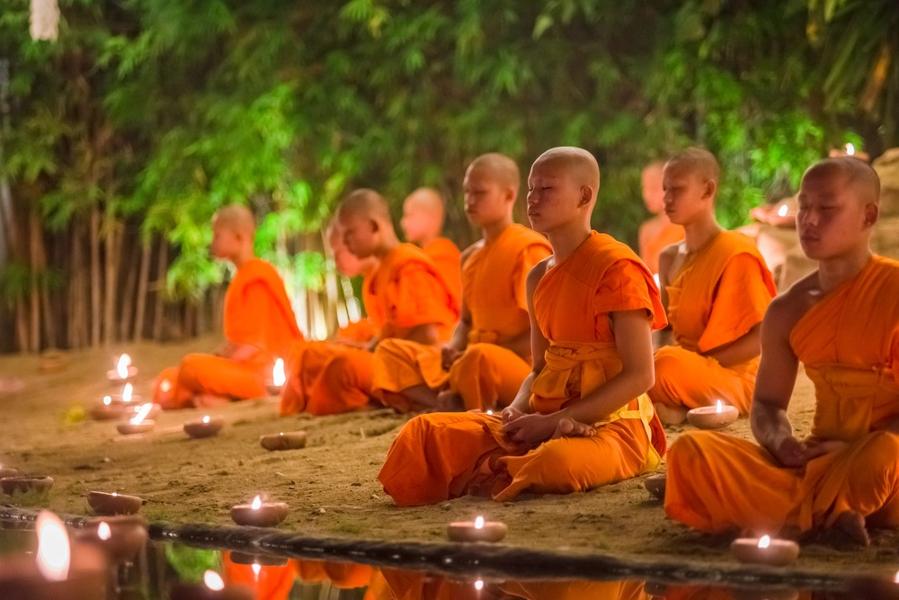
Speaking of which, know that most centers require meditation practice in white clothing. In addition to embodying purity and inner peace, this color sets practitioners apart from Buddhist monks dressed in « saffron robes »; an orange color worn as a symbol of renunciation of the material world.
Finally, this white attire is also another way to make no distinctions within a group, by imposing simplicity and modesty, to put all practitioners on equal footing.
Participating in Monastic or Center Life
The Welcome
A typical day during a Thailand retreat can vary depending on the center, but this overview will give you a good idea of what to expect during a meditative stay.
Upon arrival, a traditional ceremony — incense, candles, flowers — often marks the beginning of the retreat. It's an opportunity to meet teachers and fellow retreat participants and to experience a first moment of quiet reflection.
Community Life
During the stay, meditators participate in daily life. Everyone is invited to contribute to common tasks: sweeping paths, cleaning shared spaces, or helping in the kitchen, depending on current needs.
Meals, taken collectively, follow a fixed schedule: breakfast around six o'clock, lunch at eleven o'clock – the last meal of the day, to free up time for meditation.
The food is simple (and often vegetarian). Meals are eaten in silence, seated on benches or on the floor. Afterward, everyone washes their dishes before resuming the day's program.
Meditation and Yoga Practice
The practice of meditation and yoga varies depending on the center, but one constant remains: regularity. Exercises focus on breathing, slow conscious walking, sometimes supplemented by yoga sessions. Progress is built on attentive repetition. It is estimated that approximately three weeks of devoted practice is needed to develop a certain stability in your meditation.
Returning to Your Room
In the evening, meditators return to their room around 9 p.m. or their dormitory, for a night's rest – usually on modest bedding, following the precept of « renouncing comfort ».
Gut zu wissen
Spirituality at the Heart of Daily Thai Life
Arriving in the 3rd century BCE with the first Indian monks, Buddhism is now an integral part of Thai culture:
Spirituality accompanies daily life. Temples and stupas feature numerous meditation spaces, adorned with frescoes illustrating the life of Buddha.
In the kitchen, monastic influence is reflected in the simplicity of dishes: vegetarian recipes, absence of pork in certain traditional dishes
Buddhist festivals also honor meditation, such as Khao Phansa – the Buddhist Lent, a time conducive to contemplation and meditation, when monks retreat and follow stricter rules than usual.
According to the Pew Research Center survey on religious practices in Southeast Asia: 62% of Thais report practicing meditation!
This is likely due to its promises (such as finding inner peace, letting go of material pursuits), but also to its accessibility. Indeed, meditation is a discipline accessible to all, regardless of age, background, or religion (even non-religious people practice Buddhist meditation).
Different Meditation Techniques
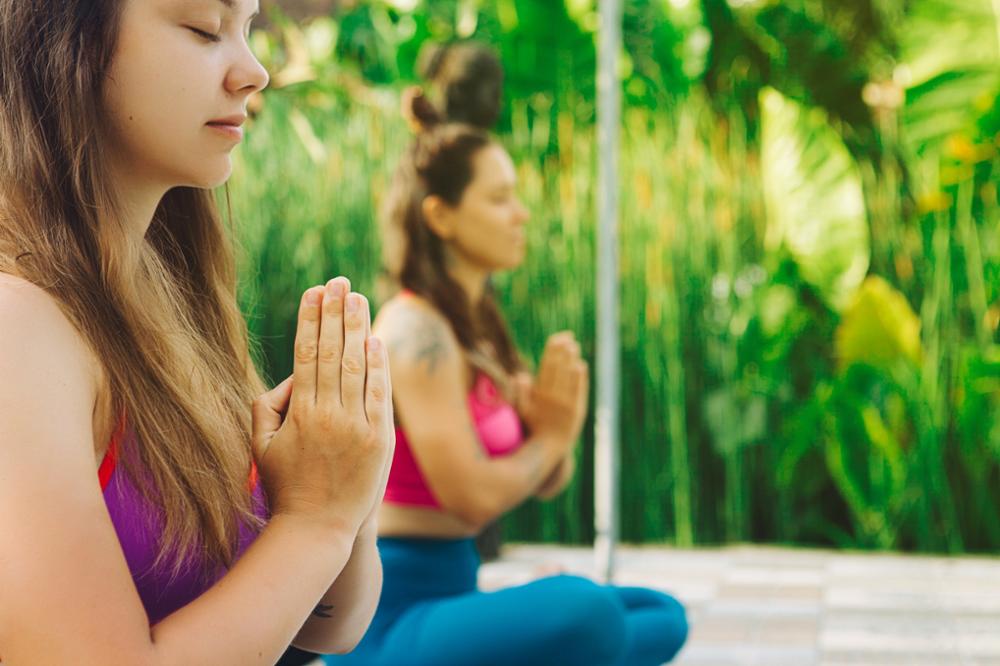
Meditation allows practitioners to rediscover inner peace. In other words, it's a way to become familiar with yourself and find a certain harmony with your surroundings.
The methods are numerous and some meditation techniques date from the pre-Buddhist period, while others developed after the appearance of Buddha.
All require good mastery of concentration and attention. Among the many meditation techniques, here are two that most monasteries and Buddhist centers practice in Thailand:
Samatha Meditation
Samatha meditation (which means « dwelling in peace ») is a technique that involves purifying your mind and calming your body to free yourself from all kinds of suffering. It is practiced seated, more precisely in the lotus position. In Thailand, this type of meditation is taught using the Mantra, a method that invites participants to recite a series of words while breathing in a specific way to achieve optimal concentration. As a fun fact, this method is said to have been taught by Buddha to his disciples.
Vipassana Meditation
Originating in India, Vipassana meditation is one of the oldest techniques. It is based on awareness of your body, its movements, and your mind. To master it, you need patience and determination, and the ability to disregard external stimuli. This is why most Vipassana meditation initiation programs take place over several days (or even weeks) in remote and quiet locations.
Taught for millennia, Vipassana meditation is considered a natural remedy for universal suffering – by inviting us to understand the origin of our suffering, to free ourselves from it. Among these afflictions:
Dukkha: suffering, physical or psychological pain,
Tanha: desire, craving, greed, yearning,
Dosa Sutta: aversion, anger,
Moha: illusion, delusion.
Anapanasati Meditation
Anapanasati meditation, or « attention to the breath », is one of the oldest Buddhist practices. It involves observing your breath naturally, without effort, to calm the mind and improve concentration, while cultivating mindfulness. After each session, it is important to exit slowly from the practice, gently reintegrating your surroundings to facilitate the transition between meditation and daily life.
Where to Do a Spiritual Retreat in Thailand?
There are numerous meditation locations in Thailand. Meditative retreats can be done in temples and monasteries, but also in dedicated, non-religious centers. Here are 4 places where you can practice meditation and/or yoga:
1. Suan Mokkh Meditation Center (The Garden of Liberation)
At the Suan Mokkh monastery, founded by Buddhadasa Bhikkhu, Anapanasati meditation is practiced according to the sixteen stages of Pāli – ancient Buddhist Theravāda texts. It begins with awareness of breathing, followed by attentive observation. Over time, the practice helps you better understand the interconnection between body and mind.
The Suan Mokkh center is located in Surat Thani, on Thailand's southern coast, 600 km from Bangkok. Meditation stays are silent retreats of 10 days, starting on the 1st of each month.
The facility indicates that white clothing is not mandatory but recommends bringing:
slippers (shoes are prohibited within the monastery),
mosquito repellent,
a bath towel,
an umbrella or raincoat, during the rainy season.
Praktische Infos
Address: 68 Lamet, Chaiya District, Surat Thani 84110, Thailand
Stay Conditions: each stay runs from the 1st to the 11th of each month. Each participant commits to this duration. Shorter stays are not possible.
Registration: registration must be done in person on the last day of the previous month.
Note: the stay is not suitable for fragile people or those suffering from psychological disorders.
2. Wat Mahathat Yuwaratrangsarit Temple (Bangkok)
Located in the Wat Maha That Yuvarat Rangsarit Ratchaworamahawihan temple in Bangkok, the International Buddhist Meditation Center offers Vipassana meditation classes as well as multi-day retreats, with a financial contribution, such as a donation to cover water, electricity, and meal expenses.
Praktische Infos
Address: 3, 5 Maha Rat Rd, Phra Borom Maha Ratchawang, Phra Nakhon, Bangkok 10200
Registration: contact the temple
Note: meditation classes are available in English.
3. Wat Pah Nanachat Meditation Center
In Ubon Ratchathani, you will find the Wat Pah Nanachat Meditation Center. Translated as « forest temple », this facility, founded in 1975, allows you to live according to monastic rhythms, in an isolated setting. Once again, the teaching method employed is Anapanasati. Each day, practitioners have several hours to dedicate to meditation.
Praktische Infos
Address: Bung Wai, Warin Chamrap District, Ubon Ratchathani 34310, Thailand
Stay Conditions: each practitioner commits to participating in the monastery's daily life and precepts.
Required Level: the center indicates that meditators should have prior meditation experience before coming to Wat Pah Nanachat.
Official Website: https://www.watpahnanachat.org/
Note: meditation classes are available in English.
4. Northern Insight Meditation Chang Mai Center
Located in Chang Mai, the Northern Insight Meditation center is one of Thailand's most renowned. Here, the method for learning meditation is Vipassana. Each day, instructions and guidance are provided to practitioners. Retreats last 26 days and accommodation and meals are free.
The center emphasizes that meditation programs are not a commercial activity. Financial contribution is not mandatory, however donations are welcomed.
Praktische Infos
Address: CMCJ+7MP Ban Luang, Chom Thong District Chom Tong Chiang Mai 50160, Thailand
Required Level: center accessible to all.
Official Website: https://northernvipassana.org/en/
Note: meditation classes are available in English.
Häufig gestellte Fragen
Costs vary by center: some monasteries operate on a donation basis, others ask for a contribution of €50 to €200 for 10 days, including accommodation and vegetarian meals.
The dry season (November to February) offers the best weather conditions. Avoid the rainy season (June to October) unless the center has appropriate covered facilities.
Some centers offer translations or deutschsprachig instructors. Since meditation is often silent, the language barrier remains manageable with preparation.
Meditation is a common practice in Thailand. Many Thais practice the discipline in their daily lives or in temples. This discipline is also taught in some primary schools.
The main meditation techniques taught in Thailand are Samatha (concentration meditation), Vipassana (observation of mind and body) and Anapanasati (attention to the breath). These three practices are accessible in many monasteries and dedicated centers.